Wind
Camping in High Wind With Kids
Fall cold fronts arrive as wind. A forecast that reads 18 mph sounds like nothing and then flattens the canopy at 2 a.m. Here is how to read the numbers, where to put the tent, how to stake it so it stays, and the point where the right move is to drive home.
By William Blacklock · Last updated September 2026


What the forecast is actually telling you
Two numbers matter and most people only read the first one. Sustained wind is an average over a couple of minutes. A gust is a short peak, and it commonly runs half again as fast as the sustained number or more. A forecast of 18 mph gusting to 35 is not an 18 mph day. It is a day with 35 mph hitting your rainfly repeatedly, and 35 is the number that bends poles.
- Under 15 mph. Normal camping. Leaves and small branches move, the tarp flaps, nothing needs a plan.
- 15 to 25 mph. The range this guide is really about. Perfectly campable with a sheltered site, a correctly oriented tent, and every stake in the ground. Paper plates are done for, the canopy comes down, and cooking moves behind the car.
- 25 to 30 mph sustained. Unpleasant. Whole trees are moving, the tent is loud all night, and a family with small kids usually has a bad time even when nothing goes wrong.
- 30 mph sustained or a high wind warning. Go home, and go in daylight. This is the same threshold our camping when the weather turns guide uses for the bail decision, and the reasoning is the same: leaving early is a minor disappointment, and leaving at midnight in the dark is a different kind of trip.
Check the hourly forecast rather than the daily one, because wind is rarely constant. Fronts in fall often arrive as a sharp afternoon build that peaks in the evening and drops back overnight, which means the tent you pitched in a calm 4 p.m. is being tested at 9 p.m. Look for the peak, and set up for that.
Let the site do most of the work
Nothing you do to a tent beats putting it somewhere the wind is weaker. Campground maps do not label this, so it is a walking decision made on arrival, before anything comes out of the car.
- Get behind something solid. A stand of trees, a hillside, a hedge of brush, a boulder, or a rise in the ground. Even a modest windbreak takes a startling amount of force out of the air immediately behind it.
- Avoid the open shot. Lakeshores, meadows, ridges, and the beach side of a dune are the sites people book for the view and regret in a blow. Water and open grass give wind a long, uninterrupted run at you.
- Look straight up first. Dead limbs, hung-up branches, and leaning trunks come down in exactly this weather, and a falling limb is the actual danger at a windy campsite. If there is anything dead, rotten, or already partly detached overhead or uphill of the tent, pick another spot. No amount of shelter is worth camping under one.
- Use the vehicle. Parking the car broadside to the wind and setting the kitchen in its lee is the single most useful thing a car camper can do about wind, and it costs nothing.
- Watch the neighbors. If every tent in the loop has its door facing the same direction, that is local knowledge for free.
If you are still choosing a site on a reservation map, our how to choose a family campsite guide covers what the listing tells you about exposure before you book.
Pitch for the wind, not for the view
A tent is a wing. Which way it faces decides whether the wind flows over it or gets under it, and the difference between a noisy night and a broken pole is usually orientation.
- Narrow end into the wind. Present the smallest, lowest profile you have. On a dome tent that is usually a corner or the short side; on a cabin tent it is the short wall. Never leave a large flat wall broadside to the gusts.
- Door downwind. An open door facing into the wind inflates the tent like a parachute and lifts it off the ground. Facing the door away also means the vestibule stays usable and you are not fighting the zipper every time a kid goes in or out.
- Stake the floor before you raise it. In real wind, stake two windward corners of the floor first, then thread the poles. A loose tent body on a windy site gets away from you, and an unstaked tent with poles in it is a kite with your sleeping bags inside.
- Load it early. Sleeping bags, pads, and a duffel inside give the tent weight while you finish. This is also why an unoccupied tent is the one that ends up in the next loop.
- Tension the fly, then re-tension it. A taut fly sheds wind. A slack one beats itself against the tent body all night and keeps everyone awake. Lines stretch as the temperature drops, so walk the guylines once more right before bed.
Our how to set up a family tent guide walks the whole pitch step by step, including the guyline hitch. This page is the version where the steps people skip are the ones that matter.
Stakes are the cheap part everyone skips
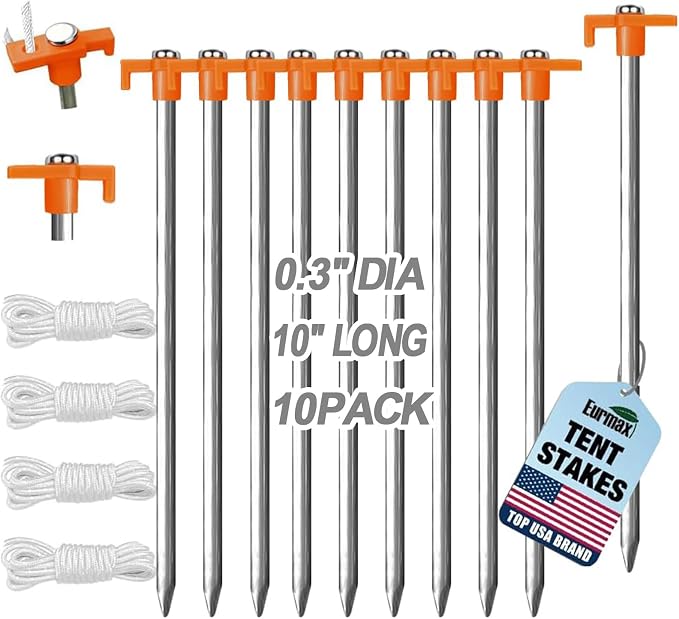
The stakes that ship with an affordable family tent are thin wire pins. They are fine on a calm night in soft dirt and they pull straight out of the ground under a loaded guyline. This is a ten dollar problem that people discover at 1 a.m.
- Angle them. Drive each stake at roughly 45 degrees with the head leaning away from the tent. A vertical stake levers out of the soil; an angled one gets pulled deeper by the load.
- Use every loop. Family tents have stake points along the floor edges and not just at the corners. In wind, all of them go in.
- Guy out at 45 degrees. A guyline run steeply down the side of the fly does almost nothing. The angle away from the tent is what converts the line into resistance.
- Carry steel. Ten inch galvanized stakes hold in soil that spits out wire pins, and they survive being hammered into hard ground with a rock or a mallet.
- Soft ground needs more. In sand or loose duff, bury a stake horizontally a foot down with the line tied to its middle, or fill a stuff sack with sand and bury that. Both hold far better than anything driven straight down.
- Make lines visible. Reflective guylines exist because a taut cord at shin height in the dark is how kids and adults go down. Tie a bandana on anything that is not reflective.
Everything loose becomes a projectile
The gear that gets damaged in wind is almost never the tent. It is the collection of light, flat, hollow things scattered around a family campsite, and the fix is a five minute sweep before dark.
- The pop-up canopy comes down. Every night. It is the single most common casualty, it is expensive, and it is the thing most likely to hurt someone when it goes. Stake and weight it when it is up, and collapse it before bed regardless of the forecast.
- Camp chairs fold and go in the car. An empty camp chair travels impressively far.
- Air mattresses and foam pads never air out unattended. A foam pad in wind is a sail.
- Stake the trash can or stow it. A collapsible can full of light packaging empties itself across the loop, which is both rude and a wildlife problem.
- Tablecloths, paper plates, and bags. Use a bin with a lid instead, and plan meals that do not rely on anything a gust can take. Our no-cook camping meals ideas travel well on a night when the wind is winning.
- Weight things with gear, not rocks, over sleeping areas. Anything you put on top of a tent or canopy to hold it down can come off in a gust.
Cooking and fire when the wind is up
Wind wrecks cooking in two different ways: it blows the flame out, and it steals the heat before it reaches the pot. Both are solvable. Fire, on the other hand, is frequently the thing to give up on.
- Build a break. Park the car upwind of the stove and cook in its lee, or set up against a picnic table turned on its side. A stove with a windscreen and a break boils water in a fraction of the time.
- Expect to burn more fuel. Wind can double the time a pot takes. Bring the spare canister.
- Never run a stove, grill, or lantern inside a tent. This is not a wind rule, it is a carbon monoxide rule, and the temptation is highest on exactly the nights people break it.
- Check restrictions on the day. Wind plus dry fuel is what drives fire bans and National Weather Service red flag warnings, and both appear on short notice. Campground boards and forest websites carry the current status.
- Skip the fire above about 20 mph. Embers travel far in wind, a fire ring does nothing to stop that, and starting a wildfire is a life-changing mistake. Our how to start a campfire guide covers the conditions worth lighting one in, and this is not one of them.
- Drown it completely. If you do have a fire earlier in the day, put it out with water until it is cold to the touch before the evening wind arrives.
Kids, wind, and the long noisy night
Wind is loud inside a tent, and a flapping rainfly at 11 p.m. reads to a five-year-old as something trying to get in. Most of the parenting work here is expectation setting done in daylight.
- Name the sound before bedtime. Tell them the tent will be noisy, explain that the noise is the fly doing its job, and have them touch a taut guyline so they understand what is holding the tent. Surprise at midnight is the problem, not volume.
- Give them the stake job. A kid with the assignment of checking every stake before bed is a kid who is not frightened of the wind, and the check is genuinely useful.
- Dress for the wind chill, not the thermometer. Moving air pulls heat off a small body fast. A 45 degree evening with a 20 mph wind feels closer to the mid 30s, so hats and a wind layer matter more than another fleece. Our how to keep kids warm camping guide covers the sleep system underneath that.
- Eyes and hair. On sandy or dusty sites, wind means grit in eyes. Sunglasses in the daytime and a hood at night are enough.
- Move the evening. A windy night is a bad night for a lantern-lit craft on the picnic table and a fine night for a story in the tent or a card game in the car with the dome light on.
When to pack up
The wind decisions that go badly are the ones made after dark, in the middle of the event, with tired kids. Set the threshold in advance and act on it while you can still see.
- Sustained wind forecast at 30 mph or above, or gusts forecast near 45 mph.
- A National Weather Service high wind warning or wind advisory covering your area.
- A red flag warning, which means a fire started by anyone nearby will spread fast, and the area may close on short notice.
- Poles visibly flexing, a sleeve tearing, or a stake pulling out more than once.
- Any sound of branches coming down nearby. Dead limbs do not announce themselves twice.
Leaving is not a failed trip. A family that drives home Saturday evening and eats dinner at the kitchen table has a story about the wind; a family that rides out a 40 mph night has a kid who does not want to go camping again. Our fall camping for beginners guide covers the rest of the season this weather belongs to, including the cold that arrives right behind the front.
Frequently asked
What wind speed is too windy for camping?
Under 15 mph is an ordinary day. From 15 to 25 mph is campable with a sheltered site and every stake in the ground. From 25 to 30 mph sustained it stops being fun, and at 30 mph or under a high wind or red flag warning, pack up in daylight. Watch the gust number, since gusts are what break things.
How do you keep a tent from blowing away in the wind?
Point the narrow end into the wind, stake every loop at about a 45 degree angle with the head leaning away from the tent, run out every guyline, keep the doors zipped, and leave weight inside. Swap the wire pins that came in the bag for steel stakes. Tents that blow away are usually empty, half staked, and pitched broadside.
Can you have a campfire in high wind?
Usually not, and often it is prohibited. Wind carries embers well past the fire ring, which is why fire restrictions and red flag warnings exist. Skip the fire above roughly 20 mph even when it is legal, check the current restrictions on arrival, and cook on a propane stove instead. Never run a stove inside a tent.
Is it safe to camp with kids in high wind?
In the 15 to 25 mph range, yes. The real hazards are falling limbs and flying gear rather than the wind itself, so check overhead for dead branches before you pitch and put away the canopy, chairs, and pads before dark. Dress kids for wind chill, which runs well below the thermometer reading.