How-to
How to Stake a Tent in Frozen Ground or Snow
The first cold-weather trip usually goes wrong at the same moment: the stakes that slid into summer dirt bend in half on frozen ground, or sink into fresh snow and pull straight back out. Here is how to anchor a family tent when the ground is hard as concrete or soft as flour.
By William Blacklock · Last updated November 2026


Why summer stakes fail in winter
The bag of stakes that came with a typical family tent is a set of thin wire hooks or lightweight aluminum pins. They are designed for soft summer soil, and in cold weather they fail in two different ways depending on what the ground is doing.
- Frozen ground is too hard. Once the top few inches of soil freeze, a wire pin bends before it penetrates, and an aluminum stake folds at the hook. You end up with a pile of bent metal and a tent held down by two corners.
- Snow is too soft. A thin stake slides into fresh snow easily and slides back out just as easily the first time a guyline takes a load. It has no surface area for the snow to grip.
- Most winter sites are both. A dusting of snow over frozen dirt, or a crusty layer of ice over mud that has not frozen yet, is the normal late fall condition. Plan for both and you are covered for whatever the site turns out to be.
Wind is what turns a loose stake into a real problem, and cold fronts arrive with it. Our camping in high wind with kids guide covers site choice and tent orientation for a blow. This page is about the anchors themselves.
Frozen ground: steel stakes and a pilot hole
Frozen dirt behaves like soft rock. The fix is a stake strong enough to be hammered and a technique that does not ask it to punch a fresh hole on every swing.
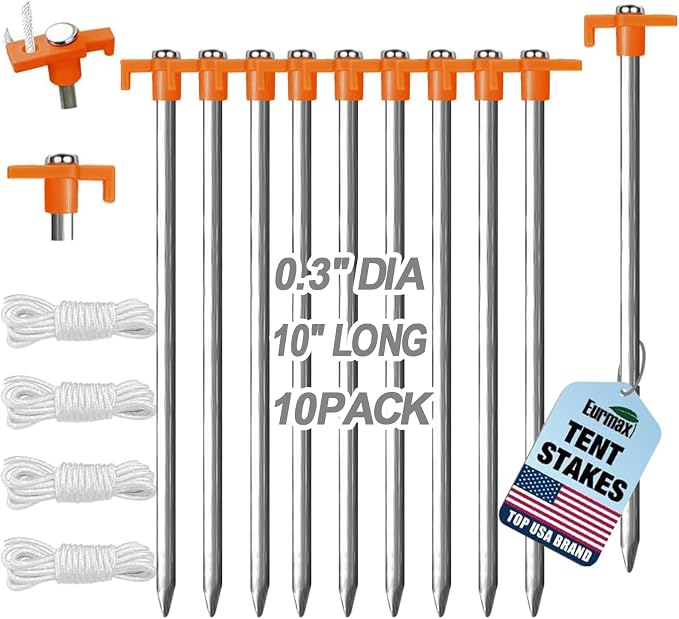
- Bring steel. Ten inch galvanized steel stakes are the cheapest upgrade in winter camping. They take real hammer blows without bending and hold in soil that spits out wire pins. Bring a few more than the tent has loops.
- Use a metal hammer. A rubber mallet bounces off frozen ground and wastes most of the swing. A small framing hammer, a steel camp mallet, or the back of a hatchet delivers the force where it needs to go. A fist-sized rock works in a pinch.
- Punch a pilot hole. Pick one stake as the sacrificial driver. Hammer it in a few inches, wiggle it out, and drive the real stake into that hole. It is far easier to widen a started hole than to break new frozen ground with each stake.
- Angle it at 45 degrees. Drive each stake with the head leaning away from the tent, the same as in summer. An angled stake gets pulled deeper by the load. In frozen ground, even three or four inches of angled steel holds surprisingly well.
- Move it if it stops dead. If a stake hits a rock or an ice lens and will not go, do not keep pounding. Shift it a few inches and try again. Bent stakes are usually stakes someone refused to move.
Timing helps more than people expect. On a clear day the sun softens the top inch or two of soil by early afternoon, so a family that pitches at 2 p.m. has a much easier time than one that arrives after dark. Then the ground refreezes around the stakes overnight and locks them in place. Our setting up camp in the dark guide covers the late arrival if you cannot avoid it.
Snow: wide stakes and deadman anchors
In snow the goal is surface area. A thin stake cuts through snow like a knife. A wide one, or anything buried sideways, has to drag a whole block of packed snow with it before it moves.
- Stamp the site first. Before the tent comes out, walk the whole footprint and the guyline area in boots, packing the snow flat. Packed snow is firmer, gives you a level floor, and holds stakes better than fluffy powder.
- Let it set. Packed snow hardens as it sits, a process called sintering. Fifteen to thirty minutes after stamping, the snow is noticeably firmer. Set up the kitchen or have a snack while it happens.
- Use wide U-shaped stakes. Aluminum U-shaped sand stakes, about a foot long, work in snow for the same reason they work on a beach. Push them in at an angle with the open side facing the tent, then pack snow over them.
- Bury deadmen for anything that matters. A deadman is a stake, a stout stick, or a stuff sack filled with snow, buried sideways 8 to 12 inches deep in a slot cut at a right angle to the guyline. Tie the line around its middle, lay it in, pack snow on top, and stamp it. Let it set before you tension the line.
- Keep the knot above the snow. Tie a short loop of cord to the buried anchor so the adjustable part of the guyline stays on the surface. You can retighten in the morning without digging, and you can find every anchor when you pack up.
If snow is only a few inches deep over frozen soil, stamp it down and drive steel stakes through it into the ground below. A thin layer of packed snow over frozen dirt is actually a good combination once you have the right stakes.
When nothing will go in: rocks, trees, and the car
Some winter campsites are gravel pads frozen solid, bare rock, or a platform you cannot stake into at all. You can still pitch securely by anchoring to things that are already heavy.
- Tie off to rocks. Wrap a guyline twice around a rock the size of a basketball or larger and tie it off. For floor loops, run a short cord through the loop and around a rock, or set a heavy flat rock directly on the stake loop.
- Use trees and fixed objects. Tree trunks, a picnic table leg, a fence post, or a bear box all make solid anchors for guylines. Check overhead for dead limbs before you tie to any tree.
- Use the vehicle. In a car campground, the bumper or a roof rack makes an excellent windward anchor. Park so the car breaks the wind for the tent as well.
- Let the tent's own weight help. A freestanding dome tent stands on its poles without stakes. Once the sleeping pads, bags, and duffels are inside, the floor is not going anywhere. What still needs anchoring is the windward side and the rainfly guylines.
- Carry extra cord. Rock and tree anchors use far more line than stakes do. A hank of paracord in the stake bag turns a frustrating site into a workable one.
If none of that is available and the forecast calls for real wind, the right answer is to sleep in the car or move to a cabin. A loose tent at 2 a.m. in cold wind is not a risk worth taking with kids.
Getting frozen stakes out in the morning
Overnight, the ground freezes around everything you drove in. That is good while you are sleeping and annoying when you are packing up. The mistake to avoid is pulling on the tent itself.
- Never yank the loop or the guyline. Tent webbing and stake loops tear long before a frozen stake lets go, and a torn corner is a repair you will be making before the next trip.
- Let the sun help. If you can, break down the tent last, after the sun has been on the site for an hour. The stakes often loosen on their own.
- Use warm water. Pour a little warm water from a thermos around the base of a stubborn stake. Then tap the head side to side to crack the ice.
- Pull with a second stake. Hook another stake through the head or hook and pull straight back along the angle it went in. It gives you a handle without gloves sliding off thin metal.
- Dig deadmen out. Do not try to pull a buried anchor out by its line. Dig down to it, which is quick if you left the cord loop on the surface.
- Count them. Stakes disappear under fresh snow and frozen leaves. Count them into the bag so nothing is left behind.
A tent that was pitched on snow or frozen ground goes home damp. Set it up or hang it to dry within a day or two. Our how to store camping gear guide covers drying and storage between trips.
Giving kids a job in the cold
Cold hands make kids miserable fast, and standing around while adults wrestle with stakes is the coldest job at camp. Give them something useful to do instead.
- Snow stamping crew. Packing down the tent site is perfect work for kids. It keeps them moving and warm, and it genuinely helps.
- Stake counter. One kid hands out stakes and counts them back into the bag at pack-up. That is the stake that does not get left behind.
- Line holder. Older kids can hold a guyline taut while you tie it to a rock or tree. Make sure they wear gloves and keep fingers away from the hammer.
- Warm hands break. Hand warmers in mitten pockets make a long setup much more bearable. Our how to dress kids for cold weather camping guide covers the layers underneath.
The anchors are only one part of a cold-weather trip. Our winter camping for beginners guide covers sleep systems, campground choice, and the rest of the plan, and how to set up a family tent walks through the whole pitch step by step.
Frequently asked
How do you get tent stakes into frozen ground?
Use steel stakes, punch a pilot hole with one sacrificial stake, and drive the real stake at a 45 degree angle with a metal hammer rather than a rubber mallet. Pitching in early afternoon, when the surface has softened, makes it much easier, and the ground refreezes around the stakes overnight.
What is a deadman anchor for a tent?
A stake, stick, or snow-filled stuff sack buried sideways 8 to 12 inches deep, with the guyline tied to its middle. It holds against a wide block of snow instead of a thin point. Pack snow on top, stamp it, and let it set for 15 to 30 minutes before tensioning.
What do you do if you cannot get stakes in at all?
Tie guylines to large rocks, trees, a picnic table, or the car, and set heavy rocks on floor loops. A freestanding tent with gear inside holds its floor down on its own. If nothing will hold a line and real wind is forecast, sleep in the car instead.
How do you get frozen tent stakes out in the morning?
Never pull on the tent loop. Wait for the sun if you can, pour warm water around stubborn stakes, tap them loose, and pull with a second stake hooked through the head. Dig buried deadmen out rather than pulling their lines, and count every stake back into the bag.


