Bear country
Camping in Bear Country With Kids
Black bears live in about 40 states, so most families who camp are already camping in bear country. In the fall they eat for 20 hours a day. Here is the food discipline, the three rules kids can remember, and what to actually do if one walks through your loop.
By William Blacklock · Last updated September 2026


You are probably already camping in bear country
American black bears live in roughly 40 states and their range has been expanding for decades, back into places that had none a generation ago. If you camp in the Appalachians, the Northeast, the Great Lakes, the Rockies, the Sierra, or the Pacific Northwest, you are in black bear country whether or not the campground puts it on a sign.
That sounds alarming and mostly is not. Bears are not interested in your family. They are interested in calories, and a campsite is a reliable calorie source if anyone up the loop road has been careless. Nearly every bear problem at a campground traces back to a bear that learned people equal food, and a bear that has learned that lesson is the one that gets destroyed by wildlife officials later. The slogan the National Park Service has used for fifty years is still the accurate one: a fed bear is a dead bear.
The practical upshot is that your job is not defense. It is not leaving anything worth learning about.
Why fall is the season this matters most
From roughly September through November, bears enter hyperphagia, a pre-hibernation feeding drive in which they eat for up to 20 hours a day and can take in several times their normal daily calories. A bear that spent August grazing on berries a mile from the road becomes a bear willing to investigate a cooler in October.
- Range widens. Bears travel further from their summer territory looking for calories, which puts them on campground loops and roadsides they ignored in July.
- Boldness increases. Caution costs calories. The same bear that kept its distance in summer will walk through an occupied site in October.
- Daylight shrinks. Dawn and dusk are peak bear movement, and in fall those windows land squarely on breakfast and dinner. Cooking in the dark with a headlamp is exactly when people get sloppy about food.
- Crowds thin out. Fewer occupied sites means a quieter campground, which bears read correctly as lower risk.
None of that is a reason to skip a fall trip, which is the best camping season of the year. Our fall camping for beginners guide covers the cold-night side of the season, and this page covers the animal side.
The food rule, applied to a real family campsite
Every bear-country rule reduces to one sentence: if it has a smell, it is locked up. Where families go wrong is in underestimating how long that list is once kids are involved.
What goes in the bear box or the locked car
- All food, including sealed and canned food, and including the dry bin.
- The cooler. Always, every night, no exceptions. A cooler on a picnic table is not storage, and a bungee cord is not a latch. If you are still working out cooler logistics, our how to pack a cooler guide assumes it gets moved at night.
- Trash and recycling, including the bag you were going to take out in the morning.
- Dirty dishes, the wash basin, sponges, and the dish soap.
- The camp stove and the grill grate, which hold grease smell after every meal.
- Toothpaste, deodorant, sunscreen, bug spray, lip balm, hand sanitizer, and wet wipes.
- Anything in a kid backpack. This is the one that catches people. Half-eaten granola bars, a juice box, a pocket full of fruit snacks from the drive up.
- Pet food and dog bowls.
If the site has a steel bear box, use it, and close the latch fully every single time including the trip back for a fork. If there is no box, your locked car with the windows all the way up is the standard substitute in most developed campgrounds, and the trunk is better than the back seat. In a handful of parks with very habituated bears, vehicle storage is prohibited outright and only the box counts, so read the campground handout rather than assuming.
Sleeping clean is the part families skip
A tent is fabric. It stops weather and nothing else, and whatever smells inside it is announcing itself to anything with a nose. The habit worth building is that the tent holds people, sleeping bags, clothes, and lights, and nothing else.
- No snacks in the tent, ever. Not a bedtime granola bar, not a water bottle with drink mix in it, not the gum in a jacket pocket. Do a pocket check on every kid at the tent door and make it a ritual rather than an argument.
- Change out of cooking clothes in heavy-bear areas. In places like the Sierra, the Smokies, or greater Yellowstone, the shirt you fried bacon in should sleep in the car. In average black-bear country this is optional, but it costs nothing.
- Brush teeth at the spigot, not at the tent. Then the toothpaste goes back in the box, not in the tent pocket.
- Keep the sleeping area away from the kitchen. The standard shape is a triangle: tent, cooking area, and food storage each well separated rather than clustered around the picnic table.
- Diaper bags count. Wipes, diaper cream, and used diapers all carry smell, and all belong in the box overnight.
Three rules kids can actually remember
Long safety talks do not survive contact with a seven-year-old. Three rules do, especially if you have them repeat the list back on the drive in and again at the site.
- Food stays out of the tent. Frame it as a rule about the tent rather than a rule about bears, because that version is easier to follow and less frightening.
- Stay where a grown-up can see you. The real risk with kids and wildlife is distance, not aggression. Bathroom trips after dark go as a group with a headlamp each.
- If you see a bear, freeze and call for an adult. Do not run, do not chase, do not hide. Say it out loud, practice it once in the daylight, and move on.
It helps to give curiosity a legitimate outlet, too. Kids who are told bears are a thing to be scared of get more scared; kids who are given a tracks-and-sign field guide and told to find evidence rather than animals end up with a project. Prints in mud near a creek, claw marks on a trailside tree, and scat on the fire road are all findable, all safe, and all a good deal more interesting than a talk about danger.
If a bear walks into your camp
The usual version of this is dull: a black bear crosses the loop road at dusk, sniffs a fire ring two sites down, and leaves. Handle it deliberately anyway, because how your family responds also decides what that bear learns.
- Group up. Gather everyone into one cluster. Pick up small children and carry the dog. A group of tall, loud shapes reads very differently to a bear than four scattered small ones.
- Make noise and make yourself big. Firm, loud voices, arms up, bang a pot. You want the bear to identify you as human immediately.
- Back away slowly, the way you came. Never run. Running looks like prey and triggers a chase response, and nobody outruns a bear - they hit 30 mph.
- Give it an exit. Do not surround it, corner it against a vehicle, or get between a mother and cubs. If cubs are present, leave the area entirely.
- Never approach for a photo. The published minimum distance in most parks is 100 yards for bears, which is a football field. This is the single most common way visitors get hurt.
- Report it. Tell a camp host or ranger. A bear working a campground is information the staff needs before it becomes a problem bear.
In the rare case of an actual attack the correct response splits by species, which is why knowing which bear lives where you are camping matters. For a black bear, fight back, and aim for the face and muzzle. For a grizzly defending cubs or a carcass, play dead: face down, hands over the back of the neck, legs spread, and stay down until it leaves. Grizzlies live in a small slice of the lower 48 - greater Yellowstone, northwest Montana, and parts of Idaho and Washington - plus Alaska. Our camping in Wyoming for beginners guide covers the food-storage rules in that corner of the map, which are the strictest in the lower 48.
Bear spray: who needs it and how it travels
Bear spray is genuinely effective, well studied, and the standard recommendation for grizzly country. It is also routinely bought by families who do not need it and will never practice with it.
- Grizzly country: carry it on trails. On a hip belt or chest strap where you can reach it in two seconds, not buried in a pack. Read the instructions at home and practice the draw with the safety clip on.
- Black-bear country: optional. For a developed campground in the Appalachians or the Great Lakes it is far down the list behind locking the cooler up.
- It is not a kid item. It is a pressurized irritant with real injury potential, including to whoever fires it into a headwind. Kids do not carry it and do not handle it.
- It does not sleep in the tent. Store it in the vehicle overnight. A punctured or heat-damaged canister in an enclosed space is its own emergency.
- You cannot fly with it. Not checked, not carry-on. Buy it near your destination if you are flying to a trip.
When there is no bear box and no car
Developed campgrounds hand you the solution. Dispersed sites, walk-in sites, and backcountry permits do not, and that is where families need an actual plan rather than a hope.
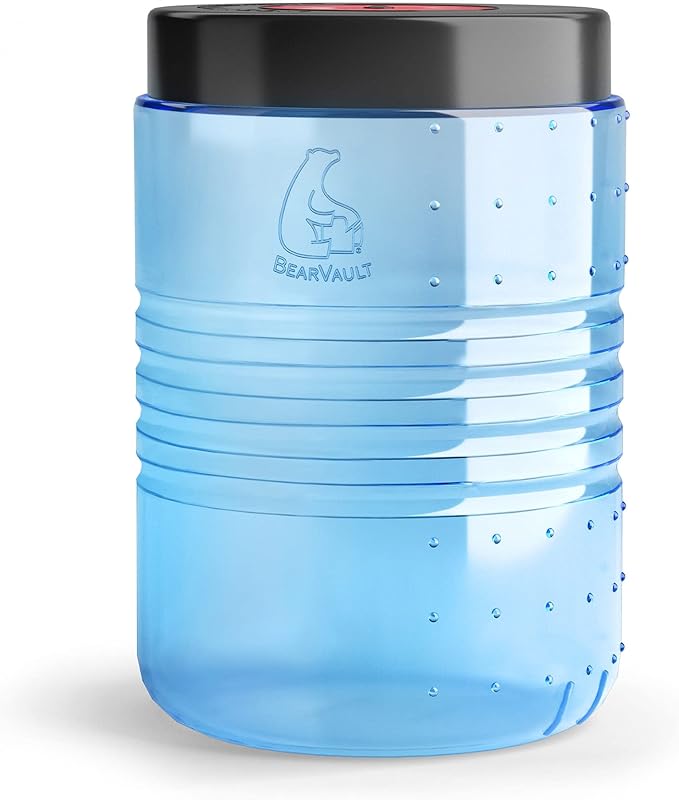
A certified bear-resistant canister is the reliable answer and increasingly the required one: a growing list of national parks and forests mandate a hard-sided canister by permit rather than accepting a hang. It is bulky and it is not cheap, but it works without skill, in the dark, in the rain, at the end of a long day, which a hang does not. Set it 100 feet from the tent and leave it on the ground, not tied to anything.
A proper hang is the fallback: 12 feet up, 6 feet out from the trunk, and 100 feet from camp. It takes a suitable branch, 50 feet of cord, and practice, and most families underestimate all three. If you are heading for federal land without amenities, our dispersed camping guide covers the rest of the rules that come with sites that have no infrastructure.
Before you book: check the specific place
Bear rules are local and they change year to year, sometimes mid-season after an incident. Ten minutes of checking beats any general advice on this page.
- Read the park or forest food-storage order for the exact unit you are visiting.
- Check whether sites have bear boxes. Campground listings usually say, and it changes which bins you pack.
- Look for a recent bear activity notice. Parks post closures and warnings for specific loops and trails.
- Find out whether a canister is required. In some parks the permit will not be issued without one.
- Confirm whether vehicle storage is allowed at that campground, since a few heavily habituated areas prohibit it.
Then do the thing that matters most on arrival: walk the site with the kids, point at the bear box, open it, close it, and let them hear the latch. Five minutes of that beats any amount of talking about it later in the dark. If you are still choosing where to go, how to choose a family campsite covers what else to look for on a campground map.
Frequently asked
Is it safe to camp with kids in bear country?
Yes. Black bears live in roughly 40 states, injuries are rare relative to the nights people spend out there, and the real risk is a bear that has learned campsites hold food rather than a bear that wants your family. Food discipline is the whole answer.
Where do you store food when camping in bear country?
In the steel bear box if the site has one, and in a locked car with the windows up if it does not. The list is longer than dinner: coolers, trash, dirty dishes, the stove, toothpaste, sunscreen, and the snacks in a kid backpack. A cooler on the picnic table is not storage.
What do you do if you see a bear while camping with kids?
Group everyone together, pick up small kids and dogs, make noise, look big, and back away slowly the way you came. Never run, never get between a mother and cubs, and never approach for a photo. Report it to the camp host afterward.
Do you need bear spray for family car camping?
Carry it on trails in grizzly country and know how to use it. In black-bear country it is optional for developed campgrounds and matters far less than food storage. It is never a kid item, it stores in the vehicle rather than the tent, and you cannot fly with it.