Big Dipper
Look north. 7 bright stars in a ladle shape.
A bingo card for the sky. Takes one clear night. Works best far from city lights - or in a backyard on a dark night.
Single-page printable · Letter / A4 · Free with email signup
Eyes need 20 minutes to fully dark-adapt - put phones away and give it time. Mark a square only when you can describe what you saw. Bingo = any row, column, or diagonal.
Big Dipper
Look north. 7 bright stars in a ladle shape.
Moon (any phase)
Counts even if not full.
Planet (brighter than stars)
Planets don't twinkle. Venus, Jupiter, and Mars are brightest.
Shooting star
A fast streak lasting < 1 second. Keep looking - your eyes need 20 min to dark-adapt.
Cassiopeia
The W or M shape on the opposite side of Polaris from the Big Dipper.
Polaris (North Star)
Follow the outer edge of the Big Dipper's cup - it points to Polaris.
Orion (Sept-Apr)
3 stars in a row = Orion's Belt. Look south in winter sky.
Milky Way band
Needs dark skies and no moon. A hazy white smear across the sky.
Airplane with blinking lights
Red + green + white blinks in a moving pattern.
Satellite (steady, moving)
A steady non-blinking dot crossing the sky in 2-5 min.
Color difference in two stars
Betelgeuse (red-orange) and Rigel (blue-white) in Orion are the easiest pair.
Summer Triangle (Jun-Nov)
Three bright stars: Vega, Deneb, Altair - directly overhead in summer.
⭐ FREE ⭐
Name any constellation you can see right now.
Little Dipper
Smaller and fainter than the Big Dipper. Polaris is at the end of its handle.
Star cluster (fuzzy patch)
The Pleiades (Seven Sisters) look like a tiny fuzzy dipper in winter.
Bat or night bird
Erratic swooping flight at dusk - not a sky object but earns a square.
Double star (two close together)
Mizar and Alcor in the Big Dipper handle - a famous pair.
Scorpius (May-Oct)
Curved tail of stars low in the south. Antares is its bright red heart.
Leo (Feb-May)
A backwards question-mark shape (the Sickle) marks the lion's head.
Fireball / bright meteor
A meteor brighter than Venus. Rare and unmistakable.
ISS pass
Brighter than any star, crosses the full sky in ~5 min. Check nasa.gov/spotthestation for pass times.
Andromeda Galaxy (Aug-Nov)
A faint smudge near Andromeda constellation - the farthest thing visible with the naked eye.
3 constellations in one night
Name all three to a witness.
Meteor shower radiant
During a shower (Perseids Aug, Leonids Nov), spot the point the meteors seem to come from.
Total of 10+ stars counted
Count out loud, point to each one. Partner must agree on every star.
 Big Dipper → Polaris
 Orion (winter)
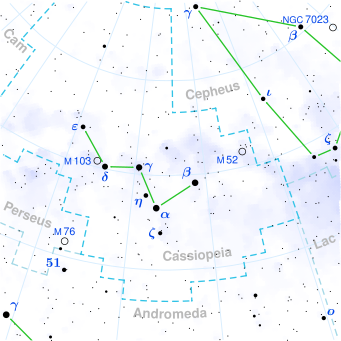 Cassiopeia (W shape)
Guides that use this printable
Want a real plan too
The printable is a great companion. Pair it with a structured plan - timeline, gear, meals, kid activities - built around your party and dates.
Start the quizTake it with you
Get this printable in your inbox
One email with the print-view link. One-click unsubscribe, no spam.