Animal Track ID Card
Track size varies by age and substrate - mud shows more detail than dust. When in doubt, look for the gait pattern: it's more reliable than print shape alone.
🦌White-tailed Deer
2-3 in long
Front Two elongated, pointed lobes (hooves) forming a heart shape. Dewclaws show in soft mud.
Hind Slightly smaller than front, same heart shape.
Gait Walking: diagonal pattern. Bounding: four tracks clustered together.
Claws No claws visible
Most common track in wooded campsites. Often found on soft soil near water.

🦝Raccoon
2-3 in wide
Front 5 long, finger-like toes splayed wide. Looks like a tiny human hand.
Hind Longer than front, heel often visible. Walks flat-footed.
Gait Hind foot prints near front foot, offset left/right.
Claws Claws visible on all 5 toes
Often found near water or trash. Mostly nocturnal - morning tracks are common.
🐇Eastern Cottontail
Front: 1 in · Hind: 3 in
Front 4 toes, small round print. Lands behind the larger hind feet when bounding.
Hind Much larger than front - elongated oval, side by side when bounding.
Gait Classic bounding Y-shape: two large hind feet forward, two small fronts behind.
Claws Faint claws on hind feet
The Y-shape bounding pattern is unmistakable. Often found at wood edges.

🐿️Gray Squirrel
Front: ¾ in · Hind: 1½ in
Front 4 toes in a tight cluster. Small and round.
Hind 5 toes, longer and wider than front. Often lands ahead of front in bounding.
Gait Bounding pairs: small fronts together, large hinds ahead - square cluster pattern.
Claws Thin claws visible
The square cluster is the key ID. Common at every campsite with trees.
🦊Red Fox
2-2½ in long
Front 4 toes in an oval, with a bar-shaped central pad. Often shows fur between toes.
Hind Nearly identical to front - slightly smaller.
Gait Direct-register trot: hind foot lands precisely in front footprint, making a straight line.
Claws Claws visible, fine and close-set
The perfectly straight line of single prints is the fox signature. Coyote is larger.
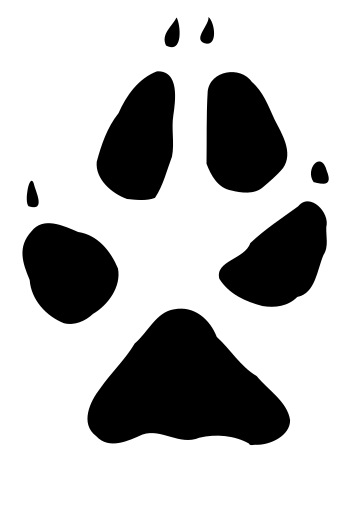
🐺Coyote
2½-3 in long
Front 4 toes, oval shape, larger than fox. Less fur between toes.
Hind Slightly smaller than front, same oval form.
Gait Direct-register trot like fox - straight line. Wider stride than fox.
Claws Prominent claws clearly visible
⚠ If pups are nearby, adults may be bold. Haze with noise if one approaches camp.

🐻Black Bear
Front: 4-5 in · Hind: 6-7 in
Front 5 toes in a wide arc above a large, chunky pad. Pigeon-toed.
Hind Much longer - resembles a wide human foot with 5 toes.
Gait Shuffling walk - hind foot lands slightly inside front track.
Claws Long curved claws up to 2 in ahead of toes
⚠ Secure all food immediately. Never leave smelly items in tent. Report to camp host.
🦨Striped Skunk
1-1½ in wide
Front 5 toes with prominent long claws (used for digging). Compact pad.
Hind Shorter claws, rounder toes. Heel visible.
Gait Slow, waddling walk - front and hind on same side move together.
Claws Very long front claws - most distinctive feature
Tracks often found near logs, disturbed soil, and grubs. Mostly nocturnal.